

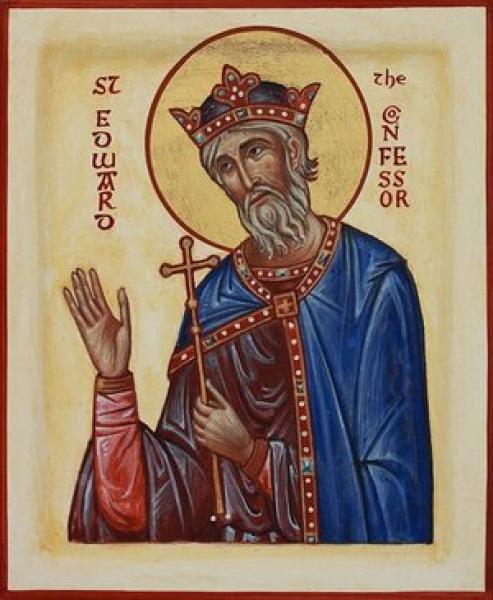
Edward the Confessor, known by this name for his extreme piety, was canonised in 1161 by Pope Alexander III. He became one of the last Anglo-Saxon kings of England, reigning for an impressive 24 years from 1042 until 1066.
The last king of the House of Wessex was born in Oxfordshire at Islip, son of King Ethelred “the Unready” and his wife Emma of Normandy. He spent much of his early life living in exile in France, his family driven away by Danish rule.
With the support of the powerful Earl of Wessex, Godwin, Edward was able to succeed the throne. His coronation took place at Winchester Cathedral on 3rd April 1043. During his reign Edward would manage affairs in a fairly consistent manner, however despite this he was faced with some skirmishes occurring both in Scotland and Wales. Edward managed a forceful campaign and in 1053 ordered the assassination of the southern Welsh prince Rhys ap Rhydderch. Furthermore, Gruffydd ap Llywelyn emerged in 1055 and declared himself leader of Wales but was forced back by the English, who forced Gruffydd to swear an oath of loyalty to the king.
Meanwhile, Edward’s leadership continued to reflect his Norman background. One of the most tangible displays of Norman influence was the creation of Westminster Abbey. The project itself was executed in 1042 and was eventually consecrated in 1065. The building represented the first Norman Romanesque church and even though it was to be later demolished in favour of Henry III’s construction, it would play a major role in developing a style of architecture and demonstration of his links to the church.
Edward’s long time abroad and clear Norman style however did contribute to a growing atmosphere of resentment. In January 1045, Edward had sought to calm any conflict between himself and Godwin, the Earl of Wessex, by marrying his daughter Edith.
Unfortunately for Edward, his position was severely compromised by the power held by the earls, in particular Godwin, Leofric and Siward. In time the earls would grow increasingly irate at the clear demonstrations of Norman favouritism exhibited by the king.
The tension boiled over when Edward chose Robert of Jumièges as Archbishop of Canterbury instead of Godwin’s relative. The new Archbishop would later accused Godwin of plotting to murder the king. Edward would seize his chance to oust Godwin, with the help of Leofric and Siward and with Godwin’s men unwilling to go up against the king, he outlawed Godwin and his family, which included Edward’s own wife Edith.
In the latter half of Edward’s reign the political picture began to alter and Edward was distancing himself from the political fray, instead engaging in gentlemanly pursuits after attending church every morning. The Godwin family would subsequently control much of England whilst Edward withdrew.
By 1053 Godwin had died leaving his legacy to his son Harold who became responsible for dealing with rebellion in the north of England and Wales. It was these actions that prompted Edward to name Harold as his successor even though it had already been established that William, Duke of Normandy would assume the throne. This inevitably led to conflict and chaos when Edward died on 5th January 1066. The issue of succession was a major contributing factor to the Norman conquest of England.