

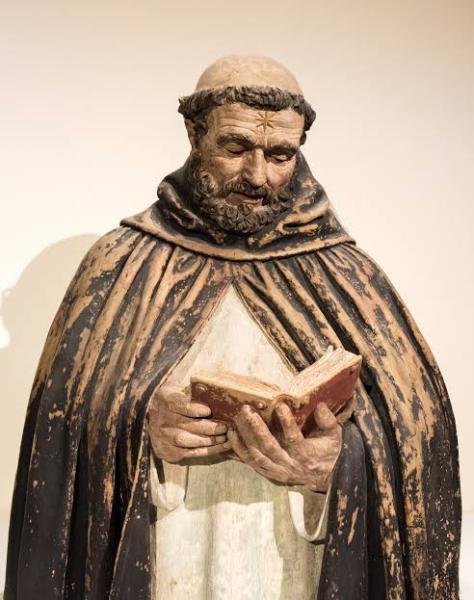
One of the challenges to the Western Christian Church of the early thirteenth century came from the Cathars, a group of Christians living around Albi in the South of France. Pope Innocent III called for a crusade to eradicate what he saw as the heresy of the Cathars - this was known as the Albigensian Crusade. Many fighting men responded to the Pope by setting about the heretics in a brutal and violent manner. Others responded by seeking to put right the beliefs of the heretics, using words rather than violence. One of these men of peace was Saint Dominic (c 1170-1221), remembered by the Church on August 8th and whose view was, 'Arm yourself with prayer, not a sword. Wear humility, not fine clothes'.
It was with prayer and humility, combined with rigorous teaching that Dominic answered a second great challenge to the Church of this period. This was the generally low standard of knowledge and understanding of the faith and poor practical application of this faith in worship. Powerful and influential the monasteries may have been, but they were seen as too isolated from the way of life of the average parishioner. What was needed was a more direct approach to Christian people in their everyday lives - an identification with their poverty and with their hand-to-mouth existence. This was provided by both Saint Francis and Saint Dominic who almost simultaneously set up their orders of friars (friar = brother).
The Dominicans were known as Black Friars because of the black cape which they wore over their white tunics and they tended to set up their houses more in towns and cities, particularly in centres of learning such as Oxford, Toulouse and Milan. Dominic was a native of Spain, who subsequently travelled widely as he encouraged his Order of Preachers to do. He expected them to live very simply from any money they were given, they were not only to preach actively but also to make time for study, prayer and meditation. The Dominicans were the first order of friars to arrive in England, followed very closely by the Franciscans and both were to have a major influence on the development of church life in this country.
The attractiveness of the early friars was in their identification with our Lord's teaching and with his command to his disciples to go out and preach the word, living as simply as possible and always associating themselves with the poor and least privileged in society. For the example he set, we are indeed indebted to Saint Dominic who died at Treviso in Italy in 1221 and who was made a saint in 1234.
Richard Allen