


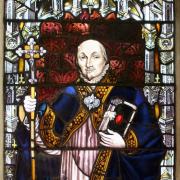
William Laud, born in 1573, was Archbishop of Canterbury from 1633 to 1645 in the days of King Charles I. It was a turbulent time throughout, one of violent divisions in the Church of England, eventually culminating in the English Civil War.
An example is the surplice controversy. In the late 1500s and early 1600s, there were Christians in England who objected to the surplice as something that the Roman Catholics had worn before the Reformation, which made it one of the props of idolatrous worship. Archbishop Laud regarded it as a seemly, dignified, garment, an appropriate response to the Apostle Paul's injunction, "Let all things be done decently and in order."
Under English Law, it was part of Laud's office as Archbishop to maintain order and to punish offences against the peace of the Church. He made it his practice to proceed not only against poor and obscure offenders, but also, perhaps especially, against rich and powerful ones. His integrity on this point ultimately cost Laud his life.
Laud made enemies chiefly in three ways. He punished those who attacked the Church; he upheld various customs in public worship (such as the wearing of the surplice) that aroused the suspicion and fury of those whe feared a return to power of Roman Catholicism and he sought the financial independence of the clergy, so that a preacher was not dependent on what support the local squire was pleased to give him. His proposed means to this end was to restore to the Church some of the Church lands that had been seized by Henry VIII, but the mere whisper of such a proposal was enough to make every landholder in the country feel personally threatened.
In 1637 an attempt was made to introduce the Book of Common Prayer into general use in Scotland, and it immediately caused rioting. In 1638, Scottish leaders pledged to uphold the Puritan position by force, and voted to depose and excommunicate every bishop in Scotland. The unrest spread to England, and in 1640 Laud was arrested on a charge of high treason. He was kept in the Tower for four years, and tried in 1644, at the age of seventy-one. He was found guilty, not because there was any evidence of his guilt, but because the House of Commons was determined that he should die. On the scaffold he prayed: "The Lord receive my soul, and have mercy on me, and bless this kingdom with peace and charity, that there may not be this effusion of Christian blood amongst them."