


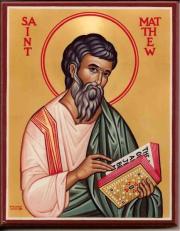
Matthew was one of the original twelve apostles. Traditionally, St Matthew was remembered as the tax-collector and as the writer of the first gospel. Modern scholars, however, advise us to distinguish between Matthew the Evangelist and Matthew the Tax Collector - they were two distinct early Christians. Matthew the Evangelist wrote his gospel towards the end of the first century. He was a Greek-speaking Jew, from Syria, who wrote very much for Jews who struggled to reconcile the Risen Christ, the Messiah, with the God of the Old Testament. And so, Matthew, in the first chapter of his gospel, was at pains to put Jesus of Nazareth into an exact genealogical setting - 28 generations back to Abraham - so that there could be no doubt about the identity of Jesus. Indeed, this gospel is sometimes called the 'Teacher's Gospel' because Matthew put together the stories and sayings of Jesus in such a way to help the young Christian church of his time. Matthew the Tax Collector, whose original name was Levi, was the son of Alphaeus. He collected taxes at Capernaum for Herod Antipas, tetrarch of Galilee. He was thoroughly disliked by self respecting Pharisees not only because he worked for the puppet regime of Herod Antipas, but because he was the host at a banquet at which other public servants and sinners were allowed to gather around Jesus. But this occasion allowed our Lord to clearly explain the purpose of his earthly ministry: [For I have come to call not the righteous but sinners] Matt 9.13. Of Matthew the Tax Collector we know very little more. He was present at the major events of Jesus' earthly life. Thereafter, all is conjecture. He may have been martyred, perhaps in Persia, perhaps in an area close to the Caspian Sea, known as Ethiopia (not modern Ethiopia). In medieval paintings he is often depicted with a money box and sometimes with spectacles as he pored over his accounts. Not surprisingly, Matthew is the patron saint of accountants, tax collectors, book keepers, customs agents and, more surprisingly, security guards.
Richard Allen