


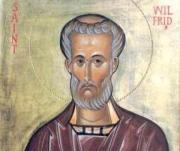
Wilfrid was a dominating influence in the Christian Church of seventh century England. He lived from 633 until 709. A saint to be remembered more for his energy and enterprise than for his holiness or humility. He was the son of a Northumbrian nobleman and, after early study at Lindisfarne, he spent many years in France and Italy. He became convinced that the ways of the Latin Church in Rome were to be preferred to those of the Celtic Church in Britain. Over matters such as the calculation of Easter Day and the correct shape of the monastic tonsure, it was Wilfrid who, at the Synod of Whitby 664, argued vehemently that the only way forward was for the church in Britain to fall in line with Latin ways. His arguments prevailed.
At one time, he was a very powerful Bishop of York, but his domineering personality brought him enemies as well as followers and, in time, he fell out with the Kings of Northumbria and with Archbishop Theodore of Canterbury. The result of these quarrels were lengthy appeals to the Popes in Rome who, although they generally supported Wilfrid, could not prevent unilateral action being taken against him in Britain. Thus, in the course of his ministry and at various times, Wilfrid found himself driven into exile from his diocese and even thrown into prison.
Yet despite such setbacks, his zeal for preaching the gospel never faltered. Shipwrecked off the coast of Frisia (present day Holland), he spent a year there converting people described as 'barbarous' by the Venerable Bede. In 681, a storm drove Wilfrid ashore on the coast of West Sussex. Sussex was the last of the kingdoms in Southern Britain to be converted - it was isolated from the rest of the country by both the sea and by the thick forests of the Weald.
So, Wilfrid set about winning the support of the King of the South Saxons, King Ethelwald, who granted Wilfrid land at Selsey. Here, he established his church and created the first centre for the present diocese of Chichester. Although all traces of these early church buildings have been submerged by the encroaching sea, the work of Wilfrid had a permanent and positive effect on Christian life in the land of the South Saxons.
After five years or so, Wilfrid returned to the north of England, but his quarrelsome ways soon brought him into disputes with fellow churchmen and rulers. Despite retaining considerable personal wealth and control over many of the monasteries which he had established, he ended his days as the Bishop of Hexham, a comparatively small diocese to the far north of the country. Wilfrid was an unashamed prince of the church. He was not always popular, but he had the drive and singlemindedness to get things done and to ensure that the work of preaching the gospel continued.
Richard Allen